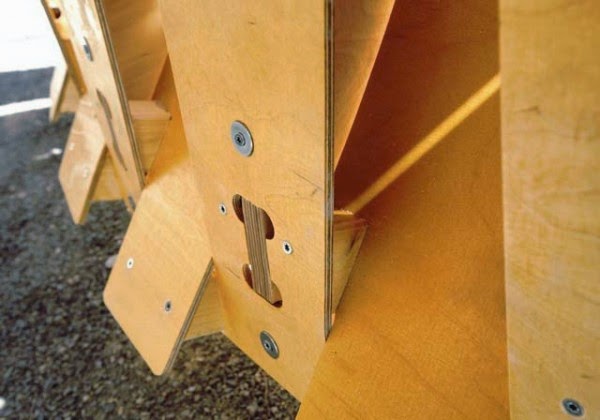
In 2010, the Institute for Computational Design and the Institute of Building Structures and Structural Design designed and constructed a temporary research pavilion. The innovative structure demonstrates the latest developments in material-oriented computational design, simulation, and production processes in architecture. The result is a bending-active structure made entirely of extremely thin, elastically-bent plywood strips.Any material construct can be considered as resulting from a system of internal and external pressures and constraints. Its physical form is determined by these pressures. Whereas in the physical world material form is always inseparably connected to external forces, in the virtual processes of computational design form and force are usually treated as separate entities, as they are divided into processes of geometric form generation and subsequent simulation based on specific material properties.
The research pavilion demonstrates an alternative approach to computational design: here, the computational generation of form is directly driven and informed by physical behavior and material characteristics. The structure is entirely based on the elastic bending behavior of birch plywood strips.The strips are robotically manufactured as planar elements, and subsequently connected so that elastically bent and tensioned regions alternate along their length.
The force that is locally stored in each bent region of the strip, and maintained by the corresponding tensioned region of the neighboring strip, greatly increases the structural capacity of the system.
In order to prevent local points of concentrated bending moments, the locations of the connection points between strips needs to change along the structure, resulting in 80 different strip patterns constructed from more than 500 geometrically unique parts. The combination of both the stored energy resulting from the elastic bending during the construction process and the morphological differentiation of the joint locations enables a very lightweight system.The entire structure, with a diameter of more than twelve meters, can be constructed using only 6.


http://www.formakers.eu/project-138-university-of-stuttgart-icditke-research-pavilion-2010


.jpg)